

Voters sent a clear message. Democrats are on track to control both the House and the Senate, which means divided government for the final two years of this administration. In our view, that reshapes the debate in Washington far more than it reshapes the outlook for your portfolio.
History puts this result in rare company. Only five times since 1910 has a President's party held both chambers heading into a midterm and lost both: 1918, 1946, 1954, 1994 and 2006. This year makes six. The common thread is the economy. In each case, voters held the party in power accountable for the pressures they felt at the grocery store, the gas pump, and the mortgage office.
Our guidance hasn't changed since before Election Day: Stay invested. Stay diversified. Let your long-term plan, not the headlines, drive your decisions.
Elections dominate the news cycle, but they rarely dominate markets for very long. What moves stocks and bonds over time is the business cycle: earnings growth, Federal Reserve policy, long-term interest rates, commodity prices, the deficit, and the pace of AI spending. A midterm has little direct say over any of them.
Gridlock in Washington has historically been nothing for markets to fear. Sometimes the less that gets done, the better. Divided government tends to rule out sweeping policy swings, and markets reward predictability.
We also expect a clean outcome. The margins in both chambers appear wide enough that a drawn-out fight over the results is unlikely.
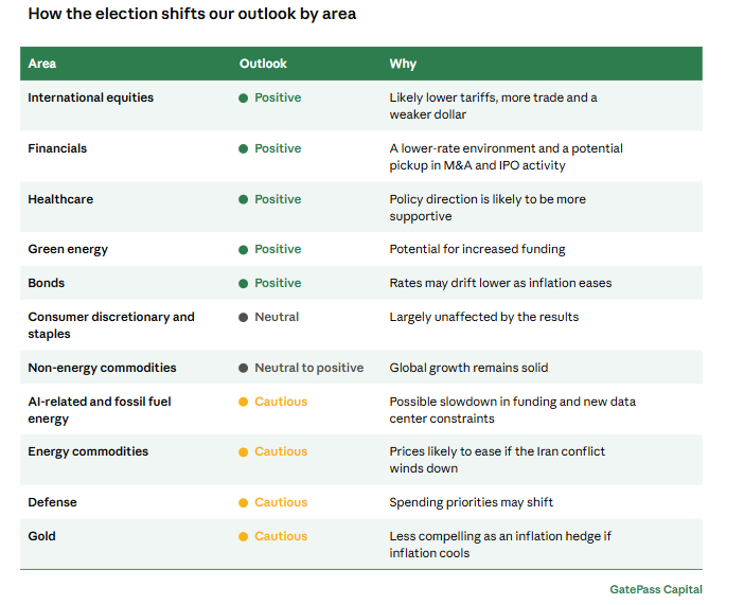
The real shift isn't new legislation. It's who controls confirmations and the agenda. A Democratic Senate now has a say over Federal Reserve governors, cabinet nominees, and any Supreme Court vacancy, and Congress sets the legislative calendar into 2028. Here's our read on the key policy areas:
Voters cast their ballots under real economic strain. Energy prices have surged since the Iran conflict began, led by diesel, jet fuel, and gasoline. Tariffs and the energy shock have pushed core inflation higher. Housing is about as unaffordable as it has ever been, consumer confidence is weak, and hiring outside of healthcare has stalled. Long-term rates have climbed too, driven largely by a deficit that keeps growing even in an expanding economy.
We see a credible path to improvement in 2027:
If one election storyline matters for markets, it's AI. Communities across the country pushed back on data center construction at the ballot box, and local measures opposing new builds carried almost across the board. The next question is whether incoming governors put limits on new projects.
Near-term capacity looks well protected. J.P. Morgan1 estimates that about 37 gigawatts of data center capacity will come online in 2027, roughly three-quarters of it already under construction. The pressure point is 2028, when about 96 gigawatts is scheduled. Based on the results, J.P. Morgan1 estimates that roughly 37.5 gigawatts could be paused and another 15 gigawatts could face new conditions, from paying for grid upgrades to water limits to losing tax incentives.
Our view is the buildout slows but stays strong. Developers will find places to build, and plenty of state and local governments will welcome the tax revenue.
Markets are already pricing in some of this. The recent AI pullback was fueled in part by hedge funds cutting exposure at the fastest pace since 2016. Investors are also scrutinizing the large lease and purchase commitments AI companies keep off their balance sheets, and credit spreads on several of the biggest names have widened. As a result, valuations for the largest AI companies relative to their expected earnings growth have reset meaningfully lower.
The calendar is on the bulls' side. Stocks have historically tended to rally around Election Day, and the logic is straightforward. The vote removes a layer of uncertainty, and whoever is in the White House then spends the year before the next presidential election working to make the economy look as strong as possible.
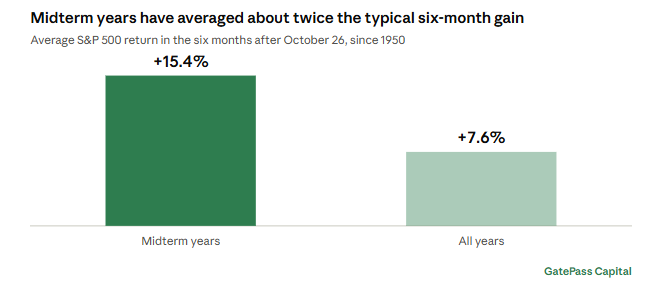
The track record is hard to ignore. According to Fundstrat2, the S&P 500 has been higher six months after October 26 in every midterm year since 1950, gaining 15.4% on average. Across all years, the average six-month gain is 7.58%.
The pattern is even stronger in midterm years when the S&P 500 was already up 5% to 20% heading into late October, as it was this year:
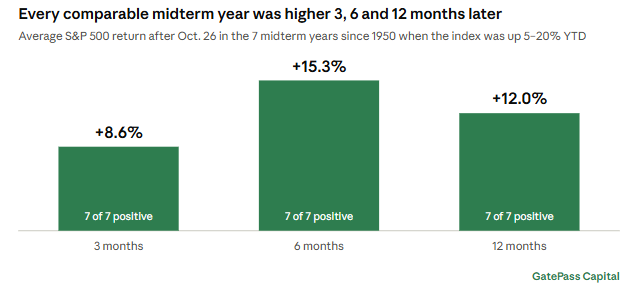
A word of caution: seven data points is a small sample, and history is a guide, not a guarantee. But when investor sentiment is this cautious, and the historical record is this one-sided, we pay attention.
Our outlook for corporate earnings remains constructive. Where the election matters is at the margin, sector by sector:
None of this calls for wholesale changes. Diversified portfolios are designed to absorb exactly this kind of political shift. We'll keep rebalancing with discipline, look for opportunities when volatility creates them, and keep your allocation tied to your goals rather than the news cycle.
Elections change who holds power. They rarely change what drives long-term returns: earnings, interest rates, and the compounding of well-run businesses.
There's plenty to watch in the months ahead, including the debt ceiling, the Fed, tariffs, and the path of AI investment. But our playbook stays the same. Markets have advanced under every combination of parties in Washington, and the investors who came out ahead were the ones who stayed the course.
If you have questions about what any of this means for your plan, please reach out. We're always here to help.
1 Eye on the Market, Michael Cembalest, JP Morgan, November 4, 2026
2 Mid-term seasonality: SPX has been higher six months after late October 19 for 19 times, Mark L. Newton, CMT, Fundstrat, October 26, 2026
GatePass Capital, LLC is a registered investment adviser; registration does not imply a certain level of skill or training. We also provide paid tax return preparation services through GatePass Tax Services, LLC and will not use or disclose your tax return information for non‑tax purposes without your written consent, as required by law (IRC §7216/§6713).
Unless otherwise indicated, commentary on this site reflects the personal opinions, viewpoints and analyses of the author and should not be regarded as a description of services provided by GatePass Capital or its affiliates. The opinions expressed here are for general informational purposes only and are not intended to provide specific advice or recommendations for any individual on any security or advisory service. It is only intended to provide education about the financial industry. The views reflected in the commentary are subject to change at any time without notice. While all information presented, including from independent sources, is believed to be accurate, we make no representation or warranty as to accuracy or completeness. We reserve the right to change any part of these materials without notice and assume no obligation to provide updates. Nothing on this site constitutes investment advice, performance data or a recommendation that any particular security, portfolio of securities, transaction or investment strategy is suitable for any specific person. Investing involves the risk of loss of some or all of an investment. Past performance is no guarantee of future results.
The best time to start is now. Personalized financial solutions don’t have to be difficult. We’d love to chat with you to learn more about who you are, what your goals are, and how we can help.
TALK TO AN ADVISOR