

As wealth grows, complexity usually grows with it. What may have started as an investment portfolio can eventually expand into multiple entities, operating businesses, trusts, real estate, private investments, charitable interests, and a growing number of family members who will one day share responsibility for it all. At that point, families are often told they need a family office.
Sometimes they do. But the more important first step is not choosing a structure. It is learning to manage family wealth the way a well-run family office would with clear governance, coordinated advice, and a long-term plan that extends beyond the current generation. At GatePass, we provide family office-style advisory services that bring together investment management, tax planning, estate coordination, governance and philanthropic strategy. The goal is not simply to manage assets. It is to help families make better decisions across every part of their financial lives.
A family office mindset goes beyond investment performance. It recognizes that a family is managing three different forms of capital:
Financial capital includes investments, businesses, real estate, cash, credit, and other assets.
Human capital includes the family members who make decisions today and those who will inherit responsibility in the future.
Social capital includes the values, charitable priorities, and community impact the family wants its wealth to support.
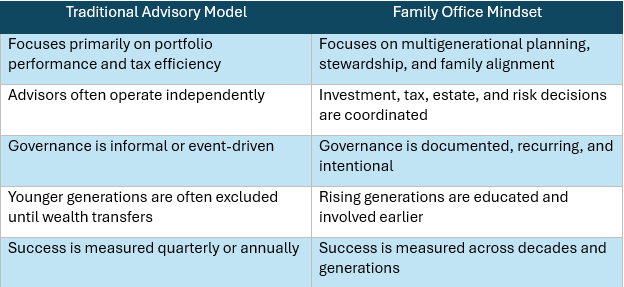
Traditional wealth management often focuses primarily on the portfolio. Governance, education, and family communication may only become priorities after a major event, such as a business sale, death, inheritance or dispute. A family office approach keeps all three forms of capital in view from the beginning. That matters because families can achieve strong investment returns and still struggle to preserve wealth across generations. The challenge is often not financial. It is a lack of communication, unclear roles, poor coordination, or no shared understanding of what the family is trying to accomplish.
Simple governance tools can help bridge that gap. These may include:
The right structure may ultimately be a single-family office, a multi-family office, or an integrated advisory relationship. But structure should follow purpose. The starting point is clarity around what the family wants its wealth to accomplish and how important decisions will be made.
Before building a new framework, families should take an honest look at how decisions are currently made. Most affluent families tend to fall into one of several informal models.
One person, often the original wealth creator, makes most major decisions. This can work for years, but it becomes a risk if too much knowledge and authority are concentrated in one person. Without a succession plan, the family may struggle when that person is no longer willing or able to lead.
The family relies on several professionals, each responsible for a different area. The investment advisor manages the portfolio. The accountant handles taxes. The estate attorney prepares documents. The insurance professional reviews coverage. Each advisor may be doing good work, but no one is responsible for ensuring all of the advice fits together. This can lead to missed opportunities, conflicting strategies, and unexpected tax or estate consequences.
A small group of family members makes decisions together, but roles and authority are not clearly defined. This can create delays, confusion, and unnecessary tension, especially as more family members and generations become involved.
A family office mindset replaces informal habits with clear answers to several important questions:
These questions may feel administrative, but they are essential to preserving both family wealth and family relationships.
Governance does not need to be overly formal or complicated. For many families, a few simple and well-documented practices can create significantly more clarity.
Start by identifying what the wealth is intended to accomplish. Is the goal to create financial security for future generations? Preserve a family business? Support entrepreneurship? Fund education? Give back to the community? Maintain family unity? Without a shared vision, family members may make individually reasonable decisions that collectively move the family in different directions.
Families should define who decides what. Some decisions may require a simple majority. Others may require consensus. Certain responsibilities may be delegated to an investment committee, trustee, or senior family member. The process does not need to be rigid, but it should be understood before a major decision or disagreement arises.
Recurring meetings create a forum to review investments, estate planning, charitable initiatives, family business matters, and future priorities. They also give younger family members a chance to ask questions and develop confidence before they are expected to make meaningful decisions. The most effective meetings address both the numbers and the broader family narrative.
Families should clearly identify who is responsible for overseeing:
It is also important to identify backup decision-makers.
Financial literacy should begin well before an inheritance occurs. Education can start with basic concepts such as budgeting, investing, taxes, and estate planning. Over time, younger family members can attend meetings, observe committees, and take on limited responsibilities. The objective is not to force every family member into a leadership role. It is to make sure they are prepared to understand and responsibly manage the wealth they may one day inherit. In our experience, the families that feel most confident are not always those with the largest balance sheets. They are the families that have aligned their decisions, documents, and relationships around a shared purpose.
Once governance is clearer, families can evaluate whether the rest of their financial lives are truly coordinated. A useful framework is to organize planning around key pillars:
Look at the entire family balance sheet, not just the brokerage accounts. This includes public investments, private investments, operating businesses, real estate, cash, and concentrated stock positions. A portfolio may appear diversified while the broader family balance sheet remains heavily exposed to one company, industry, or economic risk. Public and private investments should be evaluated together.
Tax, estate, and financial planning decisions should reinforce one another. Income tax planning may affect investment decisions. Estate structures may affect liquidity. Charitable strategies may help accomplish both tax and legacy goals. Estate documents should also reflect the family’s current structure and intentions. Documents that were prepared years ago may no longer align with the family’s assets, relationships, or governance model.
Risk management should extend across the entire family enterprise. That includes insurance, entity structure, cybersecurity, liability exposure, business continuity, and operational controls. Many families accumulate insurance policies and legal entities over time without regularly evaluating whether they still serve a purpose or work together effectively.
Philanthropy should be integrated into the broader family plan. Charitable giving can reinforce family values, improve tax efficiency, and provide a practical way for younger generations to participate in decision-making. A family foundation, donor-advised fund, or direct-giving strategy can also become a training ground for governance and stewardship.
Governance connects all the other pillars. Families should document roles, define decision-making authority, establish a process for resolving conflicts, and create a framework for evaluating new ideas. Good governance does not eliminate disagreement. It gives the family a constructive way to work through it.
Not every wealthy family needs a dedicated family office. However, certain signs may indicate that a more formal structure should be considered:
A single-family office may make sense for families with substantial complexity and the resources to build an internal team. A multi-family office can provide many of the same capabilities across a shared platform. For many families, a family office-style advisory relationship offers the best balance. It provides integrated advice and coordination without the cost and administrative burden of building a stand-alone organization.
Even families that never create a formal family office can benefit from adopting its discipline. A practical starting point may include:
These steps create a foundation for more intentional planning and smoother wealth transfer. They can also help prevent one of the most common problems affluent families face: having sophisticated financial strategies without a clear process for making decisions together. All in, a family office is not simply a collection of services. It is a way of thinking.
It means managing investments, taxes, estate planning, risk, philanthropy, and family governance as parts of one coordinated strategy. It means preparing the next generation before responsibility arrives. And it means defining success in terms of decades and generations rather than quarters and calendar years.
At GatePass, we help families bring these areas together through GatePass Preserve which is our multifamily office model or simply through our integrated family office-style approach. Whether a family needs a formal office or simply better coordination, the objective is the same: create clarity, reduce complexity and build a structure that supports both the family’s wealth and the people it is intended to serve.
GatePass Capital, LLC is a registered investment adviser; registration does not imply a certain level of skill or training. We also provide paid tax return preparation services through GatePass Tax Services, LLC and will not use or disclose your tax return information for non‑tax purposes without your written consent, as required by law (IRC §7216/§6713).
Unless otherwise indicated, commentary on this site reflects the personal opinions, viewpoints and analyses of the author and should not be regarded as a description of services provided by GatePass Capital or its affiliates. The opinions expressed here are for general informational purposes only and are not intended to provide specific advice or recommendations for any individual on any security or advisory service. It is only intended to provide education about the financial industry. The views reflected in the commentary are subject to change at any time without notice. While all information presented, including from independent sources, is believed to be accurate, we make no representation or warranty as to accuracy or completeness. We reserve the right to change any part of these materials without notice and assume no obligation to provide updates. Nothing on this site constitutes investment advice, performance data or a recommendation that any particular security, portfolio of securities, transaction or investment strategy is suitable for any specific person. Investing involves the risk of loss of some or all of an investment. Past performance is no guarantee of future results.
The best time to start is now. Personalized financial solutions don’t have to be difficult. We’d love to chat with you to learn more about who you are, what your goals are, and how we can help.
TALK TO AN ADVISOR